

How Did Donatelloã¢â‚¬â„¢s Life-size Statue Of A Soldier On Horseback Reflect Renaissance Culture?
| UNESCO World Heritage Site | |
|---|---|
 | |
| Location | Lintong Commune, Xi'an, Shaanxi, China |
| Criteria | Cultural: i, iii, iv, vi |
| Reference | 441 |
| Inscription | 1987 (11th Session) |
| Website | world wide web |
| Coordinates | 34°23′06″N 109°16′23″E / 34.385000°N 109.273056°East / 34.385000; 109.273056 Coordinates: 34°23′06″N 109°16′23″Due east / 34.385000°N 109.273056°Due east / 34.385000; 109.273056 |
| Location of Terracotta Army in China | |


| Terracotta Ground forces | |||||||||||||||||||||
|---|---|---|---|---|---|---|---|---|---|---|---|---|---|---|---|---|---|---|---|---|---|
| Simplified Chinese | 兵马俑 | ||||||||||||||||||||
| Traditional Chinese | 兵馬俑 | ||||||||||||||||||||
| Literal meaning | Soldier and equus caballus tomb-figurines | ||||||||||||||||||||
| |||||||||||||||||||||
The Terracotta Ground forces is a collection of terracotta sculptures depicting the armies of Qin Shi Huang, the starting time Emperor of Mainland china. It is a form of funerary fine art buried with the emperor in 210–209 BCE with the purpose of protecting the emperor in his afterlife.
The figures, dating from approximately the late third century BCE,[1] were discovered in 1974 by local farmers in Lintong County, outside Xi'an, Shaanxi, China. The figures vary in tiptop according to their roles, the tallest beingness the generals. The figures include warriors, chariots and horses. Estimates from 2007 were that the 3 pits containing the Terracotta Army held more than viii,000 soldiers, 130 chariots with 520 horses, and 150 cavalry horses, the majority of which remained buried in the pits near Qin Shi Huang'southward mausoleum.[2] Other terra cotta non-military figures were found in other pits, including officials, acrobats, strongmen, and musicians.[3]
History
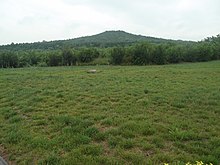
The mound where the tomb is located
The construction of the tomb was described by historian Sima Qian (145–xc BCE) in Records of the K Historian, the first of Prc's 24 dynastic histories, which was written a century afterward the mausoleum'south completion. Work on the mausoleum began in 246 BCE presently after Emperor Qin (then aged 13) ascended the throne, and the project somewhen involved 700,000 conscripted workers.[4] [5] Geographer Li Daoyuan, writing half dozen centuries after the beginning emperor'due south death, recorded in Shui Jing Zhu that Mountain Li was a favoured location due to its auspicious geology: "famed for its jade mines, its northern side was rich in aureate, and its southern side rich in cute jade; the showtime emperor, covetous of its fine reputation, therefore chose to exist buried there".[six] [7] Sima Qian wrote that the first emperor was buried with palaces, towers, officials, valuable artifacts and wondrous objects. According to this business relationship, 100 flowing rivers were fake using mercury, and to a higher place them the ceiling was busy with heavenly bodies, below which were the features of the land. Some translations of this passage refer to "models" or "imitations"; however, those words were not used in the original text, which makes no mention of the terracotta ground forces.[4] [8] High levels of mercury were constitute in the soil of the tomb mound, giving acceptance to Sima Qian'southward account.[9] Afterwards historical accounts suggested that the complex and tomb itself had been looted by Xiang Yu, a contender for the throne later the expiry of the first emperor.[x] [11] [12] Nevertheless, there are indications that the tomb itself may not have been plundered.[13]
Discovery
The Terracotta Regular army was discovered on 29 March 1974 by a grouping of farmers—Yang Zhifa, his five brothers, and neighbour Wang Puzhi—who were excavation a well approximately ane.five kilometres (0.93 mi) eastward of the Qin Emperor's tomb mound at Mount Li (Lishan),[xiv] [15] [16] [17] a region riddled with underground springs and watercourses. For centuries, occasional reports mentioned pieces of terracotta figures and fragments of the Qin necropolis – roofing tiles, bricks and chunks of masonry.[18] This discovery prompted Chinese archaeologists, including Zhao Kangmin, to investigate,[xix] revealing the largest pottery figurine group ever institute. A museum complex has since been synthetic over the surface area, the largest pit being enclosed past a roofed structure.[twenty]
Necropolis

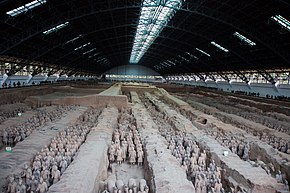
View of the Terracotta Regular army

Mausoleum of the First Qin Emperor, Hall 1
The Terracotta Army is function of a much larger necropolis. Ground-penetrating radar and core sampling have measured the surface area to be approximately 98 foursquare kilometers (38 square miles).[21]
The necropolis was constructed as a microcosm of the emperor's imperial palace or compound,[ citation needed ] and covers a large area around the tomb mound of the outset emperor. The earthen tomb mound is located at the foot of Mount Li and built in a pyramidal shape,[22] and is surrounded by ii solidly built rammed earth walls with gateway entrances. The necropolis consists of several offices, halls, stables, other structures as well equally an purple park placed effectually the tomb mound.[ citation needed ]
The warriors stand up guard to the east of the tomb. Up to 5 metres (xvi ft) of ruby, sandy soil had accumulated over the site in the two millennia following its structure, merely archaeologists found evidence of earlier disturbances at the site. During the excavations nigh the Mount Li burial mound, archaeologists found several graves dating from the 18th and 19th centuries, where diggers had apparently struck terracotta fragments. These were discarded as worthless and used along with soil to backfill the excavations.[23]
Tomb
The tomb appears to exist a hermetically sealed infinite roughly the size of a football game pitch (c. 100 × 75 m).[24] [25] The tomb remains unopened, maybe due to concerns over preservation of its artifacts.[24] For example, after the earthworks of the Terracotta Ground forces, the painted surface present on some terracotta figures began to flake and fade.[26] The lacquer covering the paint tin curl in xv seconds once exposed to Xi'an's dry air and can flake off in just four minutes.[27]
Excavation site

The museum complex containing the digging sites
Pits

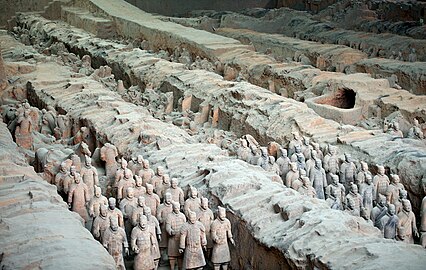
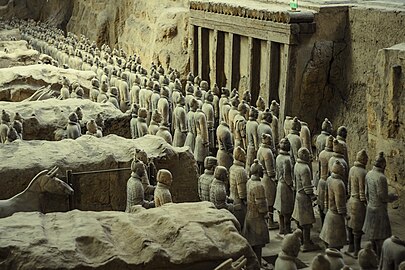
View of Pit ane, the largest excavation pit of the Terracotta Ground forces
4 chief pits approximately 7 metres (23 ft) deep accept been excavated.[28] [29] These are located approximately ane.5 kilometres (0.93 mi) e of the burying mound. The soldiers within were laid out as if to protect the tomb from the due east, where the Qin Emperor's conquered states lay.
Pit 1
Pit 1, which is 230 metres (750 ft) long and 62 metres (203 ft) wide,[30] contains the master army of more than than 6,000 figures.[31] Pit 1 has 11 corridors, near more than iii metres (10 ft) wide and paved with small bricks with a wooden ceiling supported by large beams and posts. This pattern was also used for the tombs of nobles and would have resembled palace hallways when built. The wooden ceilings were covered with reed mats and layers of clay for waterproofing, and then mounded with more soil raising them nigh ii to iii metres (6 ft vii in to 9 ft 10 in) above the surrounding ground level when completed.[32]
Others
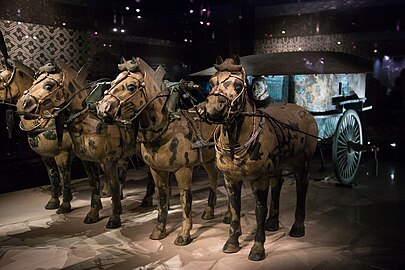
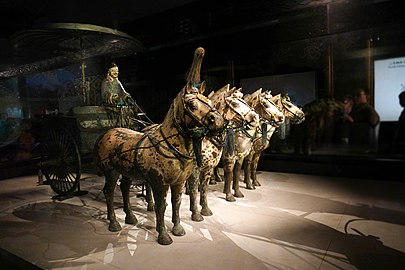
Pit 2 has cavalry and infantry units likewise as war chariots and is thought to represent a military baby-sit. Pit 3 is the command post, with high-ranking officers and a state of war chariot. Pit four is empty, possibly left unfinished by its builders.
Some of the figures in Pits 1 and 2 show burn damage, while remains of burnt ceiling rafters have besides been plant.[33] These, together with the missing weapons, have been taken as evidence of the reported looting by Xiang Yu and the subsequent burning of the site, which is thought to have caused the roof to collapse and trounce the army figures beneath. The terra cotta figures currently on display have been restored from the fragments.
Other pits that formed the necropolis have also been excavated.[34] These pits lie within and exterior the walls surrounding the tomb mound. They variously comprise statuary carriages, terra cotta figures of entertainers such as acrobats and strongmen, officials, stone armour suits, burial sites of horses, rare animals and labourers, as well equally bronze cranes and ducks fix in an cloak-and-dagger park.[3]
Warrior figures
Types and appearance

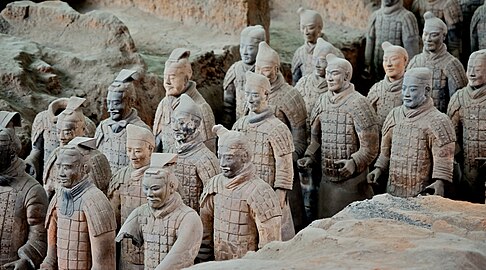
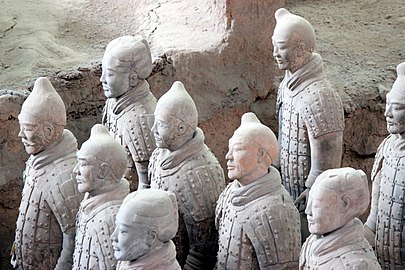
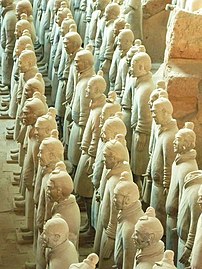
The terra cotta figures are life-sized, typically ranging from 175 cm (5.74 ft) to nigh 200 cm (6.6 ft) (the officers are typically taller). They vary in height, uniform, and hairstyle in accordance with rank. Their faces appear to be different for each private effigy; scholars, however, have identified 10 basic face shapes.[35] The figures are of these general types: armored infantry; unarmored infantry; cavalrymen who wear a pillbox hat; helmeted drivers of chariots with more armor protection; spear-conveying charioteers; kneeling crossbowmen or archers who are armored; continuing archers who are not; as well every bit generals and other lower-ranking officers.[36] In that location are, however, many variations in the uniforms inside the ranks: for example, some may wearable shin pads while others not; they may wear either long or curt trousers, some of which may be padded; and their torso armors vary depending on rank, function, and position in formation.[37] There are as well terracotta horses placed amid the warrior figures.

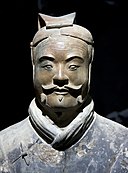
Terracotta Army General (Left), Mid-rank officer of the Terra cotta Ground forces in Xi'an (Right)
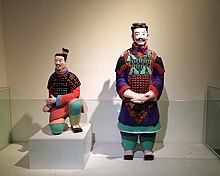
Recreated figures of an archer and an officer, showing how they would take looked when painted

Pigments used on the Terracotta warriors
Originally, the figures were painted with: basis precious stones, intensely fired basic (white), pigments of fe oxide (night red), cinnabar (red), malachite (green), azurite (blue), charcoal (blackness), cinnabar barium copper silicate mix (Chinese purple or Han purple), tree sap from a nearby source, (more than probable from the Chinese lacquer tree) (brown).[38] Other colors including pink, lilac, red, white,[39] and one unidentified color.[38] The colored lacquer cease and individual facial features would take given the figures a realistic feel, with eyebrows and facial hair in black and the faces done in pink.[twoscore]
All the same, in Xi'an's dry climate, much of the colour coating would fleck off in less than four minutes after removing the mud surrounding the army.[38]
Some scholars have speculated a possible Hellenistic link to these sculptures, because of the lack of life-sized and realistic sculptures before the Qin dynasty.[41] [42] They argued that potential Greek influence is particularly evident in some terracotta figures such as those of acrobats, combined with rare bronze artifacts made with a lost wax technique known in Hellenic republic and Egypt.[43] [44] Nonetheless, this idea is disputed past scholars who merits that there is "no substantial prove at all" for contact betwixt aboriginal Greeks and Chinese builders of the tomb, and the bases of such speculation are often imprecise or false interpretation of source materials or far-fetched conjectures.[45] [46] They debate that such speculations residuum on flawed and former "Eurocentric" ideas that causeless other civilizations were incapable of sophisticated artistry and thus foreign artistry must be seen through Western traditions.[45] [46]
Construction
The terra cotta ground forces figures were manufactured in workshops past government laborers and local craftsmen using local materials. Heads, artillery, legs, and torsos were created separately so assembled by luting the pieces together. When completed, the terracotta figures were placed in the pits in precise war machine formation according to rank and duty.[47]
The faces were created using molds, and at least ten face up molds may have been used.[35] Clay was and then added later on assembly to provide individual facial features to brand each figure appear dissimilar.[48] It is believed that the warriors' legs were made in much the same way that terracotta drainage pipes were manufactured at the fourth dimension. This would classify the process as assembly line production, with specific parts manufactured and assembled subsequently being fired, equally opposed to crafting a effigy equally one solid piece and subsequently firing it. In those times of tight royal control, each workshop was required to inscribe its name on items produced to ensure quality control. This has aided modernistic historians in verifying which workshops were commandeered to brand tiles and other mundane items for the terracotta regular army.
Weaponry

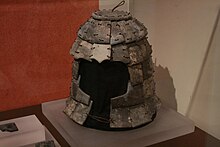
A bronze helmet unearthed from the site.

An armor unearthed from the site.
Near of the figures originally held real weapons, which would take increased their realism. The majority of these weapons were looted soon after the creation of the army or accept rotted away. Despite this, over 40,000 bronze items of weaponry accept been recovered, including swords, daggers, spears, lances, boxing-axes, scimitars, shields, crossbows, and crossbow triggers. Well-nigh of the recovered items are arrowheads, which are usually found in bundles of 100 units.[28] [49] [fifty] Studies of these arrowheads suggests that they were produced by self-sufficient, autonomous workshops using a process referred to equally cellular production or Toyotism.[51] Some weapons were coated with a ten–15 micrometer layer of chromium dioxide before burial that was believed to have protected them from any form of decay for the terminal 2200 years.[52] [53] Even so, research in 2019 indicated that the chromium was just contamination from nearby lacquer, not a means of protecting the weapons. The slightly alkaline pH and pocket-sized particle size of the burial soil most probable preserved the weapons.[54]
The swords comprise an blend of copper, tin, and other elements including nickel, magnesium, and cobalt.[55] Some carry inscriptions that date their industry to between 245 and 228 BCE, indicating that they were used before burying.[56]
Scientific research
In 2007, scientists at Stanford University and the Avant-garde Light Source facility in Berkeley, California, reported that powder diffraction experiments combined with energy-dispersive X-ray spectroscopy and micro-X-ray fluorescence analysis showed that the process of producing terracotta figures colored with Chinese purple dye consisting of barium copper silicate was derived from the cognition gained by Taoist alchemists in their attempts to synthesize jade ornaments.[57] [58]
Since 2006, an international squad of researchers at the UCL Constitute of Archaeology accept been using belittling chemistry techniques to uncover more details about the production techniques employed in the cosmos of the Terracotta Army. Using X-ray fluorescence spectrometry of 40,000 bronze arrowheads bundled in groups of 100, the researchers reported that the arrowheads inside a unmarried bundle formed a relatively tight cluster that was different from other bundles. In addition, the presence or absenteeism of metal impurities was consequent within bundles. Based on the arrows' chemical compositions, the researchers concluded that a cellular manufacturing system similar to the one used in a modern Toyota factory, every bit opposed to a continuous assembly line in the early on days of the car industry, was employed.[59] [60]
Grinding and polishing marks visible under a scanning electron microscope provide show for the earliest industrial use of lathes for polishing.[59]
Exhibitions

The first exhibition of the figures outside of People's republic of china was held at National Gallery of Victoria (NGV) in Melbourne in 1982.[61]
A collection of 120 objects from the mausoleum and 12 terracotta warriors were displayed at the British Museum in London every bit its special exhibition "The First Emperor: China's Terracotta Regular army" from thirteen September 2007 to Apr 2008.[62] This exhibition made 2008 the British Museum'southward most successful twelvemonth and made the British Museum the United Kingdom's acme cultural attraction between 2007 and 2008.[63] [64] The exhibition brought the most visitors to the museum since the King Tutankhamun exhibition in 1972.[63] It was reported that the 400,000 advance tickets sold out and so fast that the museum extended its opening hours until midnight.[65] According to The Times, many people had to be turned away, despite the extended hours.[66] During the day of events to marking the Chinese New year, the trounce was so intense that the gates to the museum had to be close.[66] The Terracotta Army has been described equally the only other set of historic artifacts (along with the remnants of wreck of the RMS Titanic) that can draw a crowd by the proper name alone.[65]

Warriors and other artifacts were exhibited to the public at the Forum de Barcelona in Barcelona betwixt 9 May and 26 September 2004. It was their most successful exhibition ever.[67] The same exhibition was presented at the Fundación Canal de Isabel Two in Madrid betwixt October 2004 and January 2005, their most successful ever.[68] From Dec 2009 to May 2010, the exhibition was shown in the Centro Cultural La Moneda in Santiago de Chile.[69]
The exhibition traveled to North America and visited museums such as the Asian Fine art Museum of San Francisco, Bowers Museum in Santa Ana, California, Houston Museum of Natural Science, High Museum of Art in Atlanta,[70] National Geographic Society Museum in Washington, D.C. and the Royal Ontario Museum in Toronto.[71] Subsequently, the exhibition traveled to Sweden and was hosted in the Museum of Far Eastern Antiquities betwixt 28 August 2010 and 20 January 2011.[72] [73] An exhibition entitled 'The Outset Emperor – Red china'due south Entombed Warriors', presenting 120 artifacts was hosted at the Fine art Gallery of New Southward Wales, between two December 2010 and 13 March 2011.[74] An exhibition entitled "L'Empereur guerrier de Chine et son armée de terre cuite" ("The Warrior-Emperor of China and his terracotta regular army"), featuring artifacts including statues from the mausoleum, was hosted by the Montreal Museum of Fine Arts from 11 February 2011 to 26 June 2011.[75] In Italy, from July 2008 to sixteen November 2008, v of the warriors of the terracotta regular army were displayed in Turin at the Museum of Antiquities,[76] and from 16 April 2010 to 5 September 2010 were exposed 9 warriors in Milan, at the Royal Palace, at the exhibition entitled "The Ii Empires".[77] The group consisted of a horse, a counselor, an archer and six lancers. The "Treasures of Ancient Communist china" exhibition, showcasing two terracotta soldiers and other artifacts, including the Longmen Grottoes Buddhist statues, was held betwixt nineteen February 2011 and 7 November 2011 in four locations in India: National Museum of New Delhi, Prince of Wales Museum in Bombay, Salar Jung Museum in Hyderabad and National Library of Republic of india in Kolkata.[ citation needed ]
Soldiers and related items were on display from 15 March 2013 to 17 November 2013, at the Historical Museum of Bern.[78]
Several Terracotta Regular army figures were on display, along with many other objects, in an exhibit entitled "Historic period of Empires: Chinese Fine art of the Qin and Han Dynasties" at The Metropolitan Museum of Art in New York City from 3 April 2017, to sixteen July 2017.[79] [eighty] An exhibition featuring x Terracotta Regular army figures and other artifacts, "Terracotta Warriors of the Start Emperor," was on display at the Pacific Scientific discipline Center in Seattle, Washington, from 8 April 2017 to four September 2017[81] [82] earlier traveling to The Franklin Institute in Philadelphia, Pennsylvania, to be exhibited from 30 September 2017 to 4 March 2018 with the addition of augmented reality.[83] [84]
An exhibition entitled "Prc's First Emperor and the Terracotta Warriors" was at the World Museum in Liverpool from 9 Feb 2018 to 28 October 2018.[85] This was the first time in more than 10 years that the warriors travelled to the Great britain.
An exhibition tour of 120 real-size replicas of Terracotta statues was displayed in the German cities of Frankfurt am Main, Munich, Oberhof, Berlin (at the Palace of the Commonwealth) and Nuremberg between 2003 and 2004.[86] [87]
Gallery





See likewise
- List of World Heritage Sites in China
- Qin statuary chariot
Notes
- ^ Lu Yanchou; Zhang Jingzhao; Xie Jun; Wang Xueli (1988). "TL dating of pottery sherds and baked soil from the Xian Terra cotta Ground forces Site, Shaanxi Province, China". International Journal of Radiation Applications and Instrumentation D. xiv (ane–2): 283–286. doi:x.1016/1359-0189(88)90077-5.
- ^ Portal 2007, p. 167.
- ^ a b "Decoding the Mausoleum of Emperor Qin Shihuang". Cathay Daily. 13 May 2010. Retrieved three December 2011.
- ^ a b Sima Qian – Shiji Volume half-dozen 《史記•秦始皇本紀》 Original text: 始皇初即位,穿治酈山,及並天下,天下徒送詣七十餘萬人,穿三泉,下銅而致槨,宮觀百官奇器珍怪徙臧滿之。令匠作機駑矢,有所穿近者輒射之。以水銀為百川江河大海,機相灌輸,上具天文,下具地理。以人魚膏為燭,度不滅者久之。二世曰:"先帝後宮非有子者,出焉不宜。" 皆令從死,死者甚眾。葬既已下,或言工匠為機,臧皆知之,臧重即泄。大事畢,已臧,閉中羨,下外羨門,盡閉工匠臧者,無複出者。樹草木以象山。 Translation: When the First Emperor ascended the throne, the digging and grooming at Mount Li began. After he unified his empire, 700,000 men were sent there from all over his empire. They dug downward deep to underground springs, pouring copper to place the outer casing of the coffin. Palaces and viewing towers housing a hundred officials were built and filled with treasures and rare artifacts. Workmen were instructed to make automatic crossbows primed to shoot at intruders. Mercury was used to simulate the hundred rivers, the Yangtze and Yellowish River, and the great sea, and set to menstruum mechanically. Above, the heaven is depicted, beneath, the geographical features of the state. Candles were fabricated of "mermaid"'s fat which is calculated to burn and not extinguish for a long time. The Second Emperor said: "Information technology is inappropriate for the wives of the tardily emperor who accept no sons to be gratis", ordered that they should accompany the dead, and a great many died. After the burial, it was suggested that it would be a serious breach if the craftsmen who constructed the tomb and knew of its treasure were to divulge those secrets. Therefore, after the funeral ceremonies had completed, the inner passages and doorways were blocked, and the exit sealed, immediately trapping the workers and craftsmen within. None could escape. Trees and vegetation were and so planted on the tomb mound such that it resembled a hill.
- ^ "Chinese terra cotta warriors had real, and very carefully made weapons". The Washington Post. 26 November 2012.
- ^ Clements 2007, p. 158.
- ^ Shui Jing Zhu Chapter 19 《水經注•渭水》Original text: 秦始皇大興厚葬,營建塚壙於驪戎之山,一名藍田,其陰多金,其陽多美玉,始皇貪其美名,因而葬焉。
- ^ Portal 2007, p. 17.
- ^ Portal 2007, p. 202.
- ^ Shui Jing Zhu Chapter 19 《水經注•渭水》 Original text: 項羽入關,發之,以三十萬人,三十日運物不能窮。關東盜賊,銷槨取銅。牧人尋羊,燒之,火延九十日,不能滅。Translation: Xiang Yu entered the gate, sent forth 300,000 men, but they could not stop carrying away his loot in 30 days. Thieves from northeast melted the bury and took its copper. A shepherd looking for his lost sheep burned the place, the fire lasted ninety days and could non be extinguished.
- ^ Sima Qian – Shiji Volume 8 《史記•高祖本紀》 Original text: 項羽燒秦宮室,掘始皇帝塚,私收其財物 Translation: Xiang Yu burned the Qin palaces, dug up the First Emperor's tomb, and expropriated his possessions.
- ^ Han Shu《漢書·楚元王傳》:Original text: "項籍焚其宮室營宇,往者咸見發掘,其後牧兒亡羊,羊入其鑿,牧者持火照球羊,失火燒其藏槨。" Translation: Xiang burned the palaces and buildings. Later observers witnessed the excavated site. Afterward, a shepherd lost his sheep which went into the dug tunnel; the shepherd held a torch to expect for his sheep, and accidentally set burn down to the place and burned the bury.
- ^ "Royal Chinese treasure discovered". BBC News. xx October 2005. Retrieved 3 December 2011.
- ^ Agnew, Neville (3 August 2010). Conservation of Ancient Sites on the Silk Road. Getty Publications. p. 214. ISBN978-1606060131 . Retrieved 11 July 2012.
- ^ Glancey, Jonathan (12 Apr 2017). "The Army that Conquered the World". BBC.
- ^ O. Louis Mazzatenta. "Emperor Qin'due south Terracotta Army". National Geographic. Archived from the original on 25 February 2017. Retrieved 22 November 2010.
- ^ The precise coordinates are 34°23′5.71″Northward 109°xvi′23.19″E / 34.3849194°N 109.2731083°E / 34.3849194; 109.2731083 )
- ^ Clements 2007, pp. 155, 157, 158, 160–161, 166.
- ^ "Archaeologist Who Uncovered China's viii,000-Man Terra Cotta Army Dies At 82". npr.org.
- ^ "Army of Terracotta Warriors". Alone Planet.
- ^ "Discoveries May Rewrite History of Prc'southward Terra-Cotta Warriors". 12 Oct 2016. Retrieved 12 Oct 2016.
- ^ 73号 Qin Ling Bei Lu (i Jan 1970). "Google maps". Retrieved 3 December 2011.
- ^ Clements 2007, p. 160.
- ^ a b "The Beginning Emperor". Channel4.com. Retrieved 3 December 2011.
- ^ "Awarding of geographical methods to explore the underground palace of the Emperor Qin Shi Huang Mausoleum". Retrieved three Dec 2011.
- ^ Nature (2003). "Terracotta Army saved from crack up". News@nature. doi:x.1038/news031124-7. Retrieved three December 2011.
- ^ Larmer, Brook (June 2012). "Terra-Cotta Warriors in Color". National Geographic. p. 86. Print.
- ^ a b "The Necropolis of First Emperor of Qin". History.ucsb.edu. Archived from the original on 20 Nov 2011. Retrieved three December 2011.
- ^ Lothar Ledderose. A Magic Army for the Emperor.
- ^ Ledderose 1998, pp. 51–73 harvnb error: no target: CITEREFLedderose1998 (help) "A Magic Regular army for the Emperor".
- ^ "The Mausoleum of the Start Emperor of the Qin Dynasty and Terracotta Warriors and Horses". China.org.cn. 12 September 2003. Retrieved 3 Dec 2011.
- ^ Portal 2007.
- ^ "Cathay unearths 114 new Terracotta Warriors". BBC News. 12 May 2010. Retrieved 3 December 2011.
- ^ "Terracotta Accessory Pits". Travelchinaguide.com. 10 Oct 2009. Retrieved 3 December 2011.
- ^ a b The Terra Cotta Warriors. National Geographic Museum. p. 27.
- ^ Cotterell, Maurice (June 2004). The Terracotta Warriors: The Secret Codes of the Emperor's Army. Inner Traditions Bear and Visitor. pp. 105–112. ISBN978-1591430339.
- ^ Cotterell, Maurice (June 2004). The Terracotta Warriors: The Secret Codes of the Emperor's Army. Inner Traditions Bear and Company. pp. 103–105. ISBN978-1591430339.
- ^ a b c Larmer, Brook (June 2012). "Terra-Cotta Warriors in Color". National Geographic. pp. 74–87.
- ^ lie, Ma (9 September 2010). "Terra cotta army emerges in its true colors". Red china Daily . Retrieved 21 July 2019.
- ^ Imperial Tombs of Red china. Lithograph Publishing Company. 1995. p. 76.
- ^ "Early links with W probable inspiration for Terracotta Warriors, argues SOAS scholar". Schoolhouse of Oriental and African Studies (SOAS), Academy of London.
- ^ Lukas Nickel (2013). The First Emperor and sculpture in China. SOAS, University of London: Cambridge University Press.
- ^ "Western contact with People's republic of china began long before Marco Polo, experts say". BBC. 12 Oct 2016.
- ^ Johnston, Ian (13 Oct 2016). "Ancient Greeks may have built China's famous Terracotta Army – 1,500 years before Marco Polo". Independent.co.uk . Retrieved 14 October 2016.
- ^ a b Hanink, Johanna; Silva, Felipe Rojas (twenty November 2016). "Why China'due south Terracotta Warriors Are Stirring Controversy". Live Science. Originally published in Hanink, Johanna; Silva, Felipe Rojas (eighteen November 2016). "Why in that location's so much backlash to the theory that Greek art inspired Cathay's Terracotta Army". The Conversation.
- ^ a b "Chinese archaeologist refutes BBC report on Terra cotta Warriors". Red china Daily 中國日報. Xinhua 新華網. www.chinadaily.com. 18 October 2016. Retrieved ix June 2021.
- ^ "A Magic Army for the Emperor". Upf.edu. 1 October 1979. Archived from the original on 28 November 2011. Retrieved 3 December 2011.
- ^ Portal 2007, p. 170.
- ^ "Exquisite Weaponry of Terra Cotta Ground forces". Travelchinaguide.com. Retrieved 3 December 2011.
- ^ Marcos Martinón-Torres; Xiuzhen Janice Li; Andrew Bevan; Yin Xia; Zhao Kun; Thilo Rehren (2011). "Making Weapons for the Terracotta Army". Archaeology International. xiii: 65–75. doi:10.5334/ai.1316.
- ^ Pinkowski, Jennifer (26 November 2012). "Chinese terra cotta warriors had real, and very carefully made, weapons". The Washington Postal service.
- ^ "Terracotta Warriors (Terracotta Army)". China Tour Guide. Retrieved 28 July 2011.
- ^ Zhewen Luo (1993). Red china's majestic tombs and mausoleums. Foreign Languages Press. p. 102. ISBN978-7-119-01619-1 . Retrieved 28 June 2010.
- ^ Martinón-Torres, Marcos; et al. (iv April 2019). "Surface chromium on Terracotta Army bronze weapons is neither an ancient anti-rust treatment nor the reason for their good preservation". Scientific Reports. 9 (1): 5289. Bibcode:2019NatSR...9.5289M. doi:ten.1038/s41598-019-40613-seven. PMC6449376. PMID 30948737.
- ^ "Terracotta Warriors" (PDF). National Geographic. 2009. Retrieved 28 July 2011. [ permanent dead link ]
- ^ "The First Emperor – Cathay's Terracotta Army – Instructor'south Resource Pack" (PDF). British Museum. Archived from the original (PDF) on 15 December 2016. Retrieved 15 June 2017.
- ^ Bertrand, Loïc; Robinet, Laurianne; Thoury, Mathieu; Janssens, Koen; Cohen, Serge X.; Schöder, Sebastian (26 Nov 2011). "Cultural heritage and archaeology materials studied past synchrotron spectroscopy and imaging". Practical Physics A. 106 (two): 377–396. doi:x.1007/s00339-011-6686-4. S2CID 95827070. [ permanent dead link ]
- ^ Liu, Z.; Mehta, A.; Tamura, North.; Pickard, D.; Rong, B.; Zhou, T.; Pianetta, P. (Nov 2007). "Influence of Taoism on the invention of the purple pigment used on the Qin terracotta warriors". Journal of Archaeological Science. 34 (11): 1878–1883. CiteSeerX10.1.1.381.8552. doi:10.1016/j.jas.2007.01.005.
- ^ a b Rees, Simon (vi March 2014). "Chemistry unearths the secrets of the Terra cotta Army". Education in Chemistry. Vol. 51, no. 2. Majestic Society of Chemistry. pp. 22–25. Retrieved 29 March 2014.
- ^ Martinón-Torres, Marcos; Li, Xiuzhen Janice; Bevan, Andrew; Xia, Yin; Zhao, Kun; Rehren, Thilo (20 October 2012). "Forty Thou Arms for a Single Emperor: From Chemic Data to the Labor Organization Behind the Statuary Arrows of the Terracotta Army" (PDF). Periodical of Archaeological Method and Theory. 21 (iii): 534. doi:ten.1007/s10816-012-9158-z. S2CID 163088428.
- ^ Jefferson, Dee (16 December 2018). "China's terracotta warriors volition visit Melbourne for National Gallery of Victoria'southward Wintertime Masterpieces series". Arts. ABC News.
- ^ "The Start Emperor: China'southward Terracotta Army". British Museum. Archived from the original on 11 August 2011. Retrieved 15 June 2017.
- ^ a b Higgins, Charlotte (2 July 2008). "Terra cotta army makes British Museum favourite attraction". The Guardian. London. Retrieved 25 May 2010.
- ^ "British Museum sees its most successful year ever". Best Western. 3 July 2008. Archived from the original on xi October 2008.
- ^ a b "British Museum ponders 24-hour opening for terracotta warriors". CBC News. 22 November 2007.
- ^ a b Whitworth, Damian (9 July 2008). "Is the British Museum the greatest museum on earth?". The Times. London. Retrieved 25 May 2010.
- ^ DesarrolloWeb (19 April 2007). "Los guerreros de Xian, en el Forum de Barcelona". Guiarte.com. Retrieved 3 Dec 2011.
- ^ "Guerreros de Xian". Futuropasado.com. Archived from the original on 19 March 2019. Retrieved 3 December 2011.
- ^ "Llegan a Chile los legendarios Guerreros de Terracota de People's republic of china". Latercera.com. Archived from the original on 21 October 2011. Retrieved 3 Dec 2011.
- ^ "Record-Breaking Terracotta Regular army Exhibition at Atlanta museum". Archived from the original on 11 July 2011. Retrieved 16 January 2010.
- ^ "ROM'south terracotta warriors show a blockbuster". CBC. six January 2011.
- ^ "China's Terracotta Ground forces, Stockholm, Sweden, Reviews". Retrieved 20 Jan 2010.
- ^ "Earth Famous Terracotta Army Arrives in Stockholm for Exhibition at Ostasiatiska Museum". Retrieved 20 Jan 2010.
- ^ "Terracotta warriors, Picassos heading to Sydney". ABC News. fourteen October 2010. Retrieved 23 January 2011.
- ^ "Empereur Guerrier De Chine Et Son Armee De Terre Cuite". Mbam.qc.ca. Archived from the original on xxx September 2011. Retrieved three Dec 2011.
- ^ "Il Celeste Impero. Guerrieri di terracotta a Torino – Il Sole 24 ORE".
- ^ "Esercito di Terracotta: dalla Cina a Palazzo Reale di Milano – NanoPress Viaggi".
- ^ "Dice Terrakotta-Krieger sind da". Der Bund. 22 February 2013. Retrieved 21 June 2015.
- ^ Age of Empires: Chinese Fine art of the Qin and Han Dynasties Metropolitan Museum of Art
- ^ 'Age of Empires: Chinese Art of the Qin and Han Dynasties (221 B.C.–A.D. 220)' Review: Treasures of Nation-Building Wall Street Journal
- ^ Upchurch, Michael (vii Apr 2017). "'Terracotta Warriors' exhibit makes thousand archway at Pacific Science Center". Seattle Times . Retrieved 10 July 2017.
- ^ "Terra cotta Warriors of the First Emperor". Pacific Science Eye. Archived from the original on 11 July 2017. Retrieved 10 July 2017.
- ^ "Why the Terra cotta Warriors are and so special, and how to see them in Philly". Philly.com . Retrieved 3 October 2017.
- ^ Hurdle, Jon (29 September 2017). "Arming Mainland china'due south Terracotta Warriors – With Your Phone". The New York Times. ISSN 0362-4331. Retrieved 3 October 2017.
- ^ "Earth Museum, Liverpool museums". www.liverpoolmuseums.org.uk . Retrieved 5 January 2018.
- ^ "Einmarsch der Chinesen". Der Tagesspiegel (in German). xvi January 2004. Retrieved v September 2019.
- ^ "Tschüss Berlin! Terrakotta-Krieger des Kaisers von China ziehen weiter". Berliner Morgenpost (in German). Deutsche Presse-Agentur. 25 July 2004. Retrieved 5 September 2019.
Bibliography
- Clements, Jonathan (18 January 2007). The First Emperor of China. Sutton. ISBN978-0-7509-3960-7.
- Debaine-Francfort, Corinne (1999). The Search for Ancient China. 'New Horizons' series. London: Thames & Hudson. ISBN978-0-500-30095-4.
- Dillon, Michael (1998). China: A Historical and Cultural Dictionary . Durham East asia series. Richmond, Surrey: Curzon. ISBN978-0-7007-0439-2.
- Portal, Jane (2007). The First Emperor: China's Terra cotta Army. Harvard University Press. ISBN978-0-674-02697-one.
- Ledderose, Lothar (2000). "A Magic Army for the Emperor". X Thousand Things: Module and Mass Production in Chinese Art. The A.Westward. Mellon Lectures in the Fine Arts. Princeton, NJ: Princeton University Printing. ISBN978-0-691-00957-5.
- Perkins, Dorothy (2000). Encyclopedia of Communist china: The Essential Reference to China, Its History and Culture. Facts On File. ISBN978-0-8160-4374-3.
External links
- UNESCO description of the Mausoleum of the Start Qin Emperor
- Emperor Qinshihuang's Mausoleum Site Museum (official website)
- People'due south Daily article on the Terracotta Army
- OSGFilms Video Article : Terracotta Warriors at Discovery Times Square
- Tomb of the First Emperor of China by Professor Anthony Barbieri, UCSB
- China's Terra cotta Warriors Documentary produced by the PBS Series Secrets of the Dead

How Did Donatelloã¢â‚¬â„¢s Life-size Statue Of A Soldier On Horseback Reflect Renaissance Culture?,
Source: https://en.wikipedia.org/wiki/Terracotta_Army
Posted by: zooksigne1995.blogspot.com
0 Response to "How Did Donatelloã¢â‚¬â„¢s Life-size Statue Of A Soldier On Horseback Reflect Renaissance Culture?"
Post a Comment